Gleba is the planet that punishes players who land unprepared, because almost nothing works the way it does on Nauvis. There are no drillable ore patches. There is no crude oil. Half the map is standing water. And every item you produce is quietly rotting.
Why Gleba Breaks Standard Landing Habits
The core problem: the standard "bring machines, mine locally" loop does not exist here. Your first hour depends entirely on a biological chain that takes time to spin up.
| Resource | Available locally? | How you get it | Landing consequence |
|---|---|---|---|
 Iron plate
Iron
Iron plate
Iron | Indirect |  Nutrients
Iron bacteria cultivation in a biochamber
Nutrients
Iron bacteria cultivation in a biochamber | Need imported plates to bootstrap |
 Copper plate
Copper
Copper plate
Copper | Indirect | Copper bacteria cultivation in a biochamber | Same bootstrap gap |
 Crude oil
Crude oil
Crude oil | No | Replaced by bioplastic / biosulfur / biolubricant | Bring processed oil products |
 Coal
Coal
Coal
Coal | Indirect | Coal synthesis | Do not plan around boilers |
 Stone
Stone
Stone
Stone | Yes | Mine patches in the dark highlands biome | Only mineable far from the marsh |
 Water
Water
Water
Water | Yes |  Offshore
 pump
Offshore
Offshore pump | Trivial, do not waste cargo space |
|
Nutrients
Nutrients | Yes | Mash from  Yumako
yumako /
Yumako
yumako /  Jellynut
jellynut fruit
Jellynut
jellynut fruit | Spoils in 5 minutes |
 Lubricant
Lubricant
Lubricant | Indirect | Biolubricant recipe | Bring barrels to start |
Note the pattern: you can make everything eventually, but not in the first 20 minutes. That gap is exactly what your rocket payload has to cover.
If you are still deciding whether Gleba is even the right second planet, check https://factorioguides.com/space-age/guide/planet-order-guide/ before you commit the launch - Aquilo later reuses the heating technology you build here, but Gleba is not mandatory as your first stop.
The Loadout: What Actually Goes In The Rocket
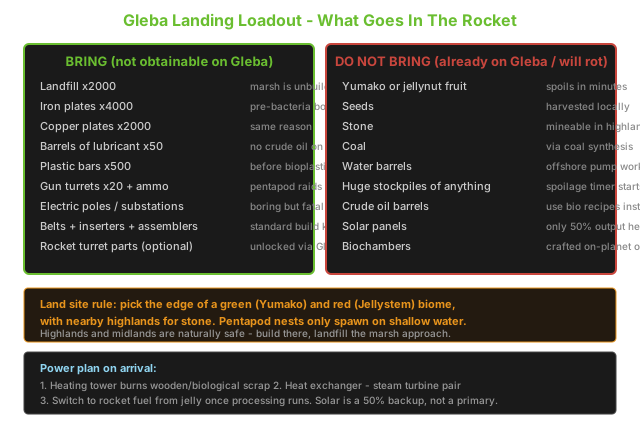
The full list, in priority order:
| Item | Quantity (one person) | Why it is irreplaceable |
|---|---|---|
 Stone brick
Landfill
Stone brick
Landfill | 2000+ | The marsh cannot be built on at all |
|
Iron plate
Iron plates | 4000 | Covers you until bacteria cultivation runs |
|
Copper plate
Copper plates | 2000 | Same bootstrap window |
|
Lubricant
Lubricant barrels | 50 | No crude oil means no lubricant refinery |
 Plastic bar
s
Plastic bar
Plastic bars | 500 | Before the bioplastic line exists |
 Gun turret
s
Gun turret
Gun turrets | 20 | Pentapods arrive fast once spores spread |
 Piercing
 rounds
Piercing
Piercing rounds | 1000 | Cheap insurance, stacks well |
 Transport
Belts, inserters, assemblers
Transport
Belts, inserters, assemblers | Full kit | You cannot build a factory without a build kit |
 Electric
Power poles and substations
Electric
Power poles and substations | Several hundred | The most commonly forgotten item on the list |
 Heating
 tower
Heating
Heating tower | 2 | Power generation and later the Aquilo prerequisite |
Landfill deserves special emphasis. Gleba's lowlands are shallow water tiles with a marbled, unbuildable surface. Your landing pad itself is fine, but the moment you want to expand outward you either find elevated terrain or pour landfill. Bring more than you think you need.
What You Must Never Bring
| Item | Why it is a mistake |
|---|---|
|
Yumako
Yumako /
Jellynut
jellynut fruit | Grows everywhere, spoils while sitting in a chest |
| Seeds | Harvested from trees you have not even planted yet |
|
Stone
Stone | Mineable in the highlands, just walk there |
|
Coal
Coal | Coal synthesis covers it once power is stable |
 Solar panel
Solar-only plans
Solar panel
Solar-only plans | Surface solar output is only 50% here |
| Large buffer stockpiles of anything biological | Buffering does not work - spoilage timers beat you |
This is the single biggest mental adjustment: throughput beats storage on Gleba. On Nauvis you can buffer 10,000 iron plates and forget about it. On Gleba,
Nutrients
nutrients have a five-minute spoil window, so anything you stockpile turns into  Spoilage
spoilage inside the container. When that eventually jams you, https://factorioguides.com/space-age/gleba/spoilage-backup/ walks through clearing a backed-up line without tearing the whole block down.
Spoilage
spoilage inside the container. When that eventually jams you, https://factorioguides.com/space-age/gleba/spoilage-backup/ walks through clearing a backed-up line without tearing the whole block down.
Choosing Your Landing Site
Pick where you drop the  Cargo
cargo landing pad before you commit the launch - relocating later is expensive.
Cargo
cargo landing pad before you commit the launch - relocating later is expensive.
The three biome rules:
- Red and green marshlands are where
Jellynut
jellystem and
Yumako
yumako trees grow. You need both.
- Dark highlands hold the
Stone
stone patches and sit above the water line, so they are directly buildable.
- Pentapod nests only form on shallow water tiles - so highlands and midlands act as natural walls against expansion.
The trick most players miss: land on a highland/midland shelf wedged against both food biomes. You get buildable ground, stone access, food adjacency, and the water being between you and nest expansion instead of around you. You can push the enemy back further later by landfilling the shallow water they would otherwise use.
First 60 Minutes: The Build Order
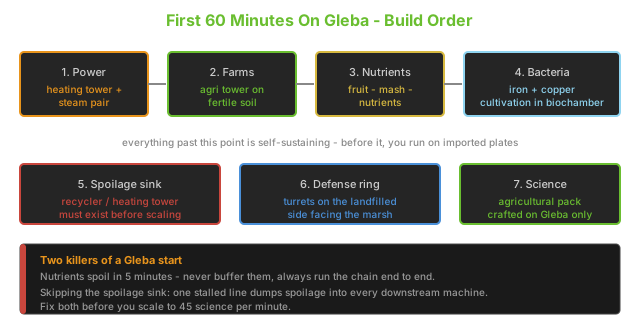
- Power first. Drop a
Heating
heating tower, attach a
 Heat
heat exchanger and steam turbine pair. This also unlocks the heating technology you will need before Aquilo.
Heat
heat exchanger and steam turbine pair. This also unlocks the heating technology you will need before Aquilo. - Farms second.
 Agricultural
 towers onto the fertile soil tiles surrounding wild trees. Do not place them on random marsh.
Agricultural
Agricultural towers onto the fertile soil tiles surrounding wild trees. Do not place them on random marsh. - Nutrients third. Fruit into mash into nutrients, headed straight into biochambers. Keep the line short - this is where the 5-minute timer bites.
- Bacteria fourth. Iron and copper bacteria cultivation inside biochambers. Only now does your metal supply become local.
- Spoilage sink fifth. Route
Spoilage
spoilage into a
 Recycler
recycler or burn it. Without a sink, one stalled machine backfills the whole line.
Recycler
recycler or burn it. Without a sink, one stalled machine backfills the whole line. - Defense sixth. Turrets on the side facing the marsh, because that is the only direction attacks come from. The perimeter layouts in https://factorioguides.com/space-age/gleba/pentapod-defense/ assume exactly this geometry, so build to match it rather than boxing yourself in.
- Science seventh.
 Agri science
Agricultural science packs can only be crafted on Gleba, so this is your export product.
Agri science
Agricultural science packs can only be crafted on Gleba, so this is your export product.
Once you are past step 4 you are self-sustaining, and the imported plates stop mattering. Most failed Gleba runs fail somewhere between step 2 and step 4, because the chain stalls and everything rots.
Power Reality Check
Solar panel
Solar panels produce at 50% effectiveness on the Gleba surface, which makes them a supplement rather than a solution. The real chain is:
| Stage | Source | Notes |
|---|---|---|
| Ignition |
Heating
Heating tower burning local scrap | Cheap, needs a manual top-up early |
| Steady state | Heat exchanger plus turbine pair | Requires water from an offshore pump |
| Scaled |  Rocket fuel
 made from jelly
Rocket fuel
Rocket fuel made from jelly | Gleba generates rocket fuel renewably |
Gleba is one of the best power planets in the game once running - it just has an awkward startup window. Your imported material should buy you through that window, nothing more.
Common Mistakes
| Mistake | What happens |
|---|---|
| Landing without landfill | You are boxed in by marsh in every direction |
| Buffering nutrients | They spoil inside the chest before you use them |
| Building before picking a biome | You end up relocating the pad and losing the launch |
| Assuming you can drill for ore | There is nothing to drill; it is bacteria or imports |
| No spoilage sink at scale | A single stall backfills the entire production line |
| Ignoring spores |  Pentapod egg
Pentapods are drawn to biological output, not pollution
Pentapod egg
Pentapods are drawn to biological output, not pollution |
Past the first hour the pressure shifts from setup to survival. Pentapod waves scale with your biological output rather than pollution, so the base you just built starts drawing attacks precisely because it is working. https://factorioguides.com/space-age/gleba/gleba-survival-guide/ covers keeping that base intact once the waves arrive, which is the point where most first landings actually collapse.
Community Verification and Resources
- Factorio Wiki: Gleba - biome properties, resource restrictions and spoil timers
- Reddit r/factorio - player-reported landing loadouts and first-hour routes
Last updated: 2026-09-26 | Verified against Factorio 2.0 / Space Age.