Before you land on Gleba, your space platform needs enough thrust and ammo for the outer planet trip—it’s a longer journey than Fulgora or Vulcanus. Gleba is the only planet where your factory actively works against you. Belt buffers that help on Nauvis rot here. Chests filled with spare parts turn into chests of spoilage. Assemblers that back up kill their own inputs. Check https://factorioguides.com/space-age/guide/planet-order-guide/ for why Gleba comes third in the planet order. The fix isn't better production — it's controlled destruction. If something isn't moving, destroy it.
| Threat | Source | Countermeasure | Building |
|---|---|---|---|
| Spoilage | All organic items | Timer flushing |  Decider
Circuit
Decider
Circuit |
| Pentapods | Spore clouds | Turret perimeter |  Gun turret
Turret
Gun turret
Turret |
| Starvation | Stalled farms | Backup energy |  Heating
Tower
Heating
Tower |
| Belt jam | Excess fruit | Priority splitter |  Splitter
Splitter
Splitter |
| Source | Input | Nutrient Output | Spoilage |
|---|---|---|---|
| Bioflux | 1 bioflux | 50 nutrients | 2 min |
| Yumako mash | 50 mash | 10 nutrients | 5 min |
| Jelly | 50 jelly | 10 nutrients | 5 min |
| Spoilage | 200 spoilage | 10 nutrients | 1 min |
The Mechanics Behind This Bottleneck
Every organic item on Gleba (and items derived from them) spoils over time:
| Item | Spoilage timer | What it spoils into |
|---|---|---|
| Yumako fruit | 1 hour | Spoilage |
| Jellynut | 1 hour | Spoilage |
| Bioflux | 30 min | Spoilage |
| Nutrients | 5 min | Spoilage |
| Bacteria | 2 min | Spoilage (no, you can't stop this) |
| Science packs | 1 hour | Spoilage |
The key insight: nutrients are the bottleneck. Nutrients spoil in 5 minutes. Every assembler that needs nutrients must be within belt distance of the nutrient source. If nutrients travel more than ~20 tiles on a yellow belt before reaching an assembler, they expire en route.
The Proven Fix — Short Belts, Circuit Control, Burn Everything
Stage 1 — Nutrient production, local to every consumer.
Don't build a central nutrient factory and belt it everywhere. Each production cluster needs its own nutrient source:
- Near fruit processing: nutrients from bioflux (lasts 30 min, more stable)
- Near bacteria vats: nutrients directly from spoilage (1 nutrient per spoilage, fast but short lifespan)
- Near science: nutrients fed directly from a local bioflux producer
Distance rule: keep any belt carrying nutrients under 15 tiles. After that, use a separate nutrient maker.

Stage 2 — Bioflux the backbone.
Bioflux (from yumako + jellynut mash) has a 30-minute timer — your most stable intermediate. Build bioflux production in bulk and let it supplement nutrients locally.
Each bioflux → 10 nutrients. 10 nutrients run one bacteria vat for roughly 2 minutes. Keep a bioflux chest buffer near each consumer cluster and convert on-demand.
Stage 3 — Burn what you can't use.
Circuit-controlled splitters (see our Circuit Network Guide for the wiring pattern) are mandatory on Gleba. Set each output splitter to:
- Enable if item < threshold (e.g., iron bacteria < 500)
- If disabled: route to a heating tower for destruction
Without this, any production line that backs up (say you have enough iron) will let bacteria spoil on the belt, filling everything with spoilage.
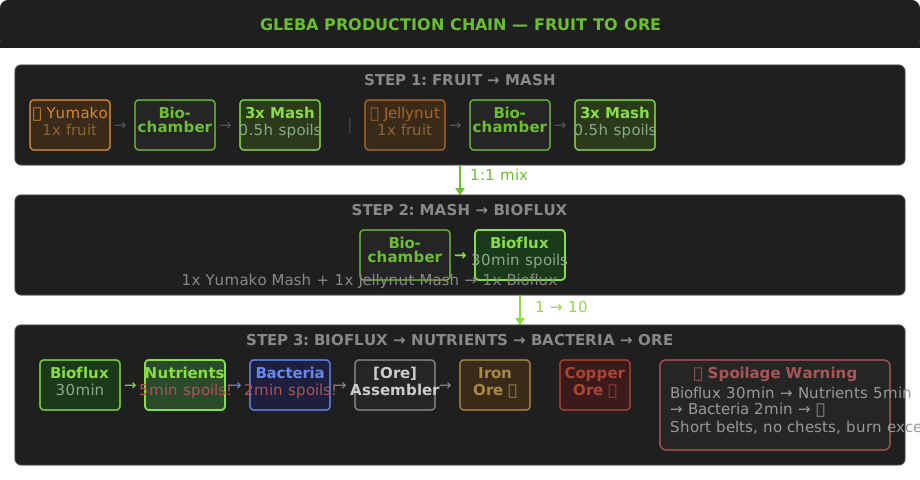
The Production Chain — What Goes Where
Yumako → Yumako mash → Bioflux:
- 1 yumako → 3 mash (in biochamber)
- 1 mash + 1 jellynut mash → 1 bioflux
- Bioflux preserved: 30 minutes
Bioflux → Nutrients:
- 1 bioflux → 10 nutrients (in biochamber)
- Nutrients preserved: 5 minutes
- Feed this to bacteria vats directly — minimal belt travel
Bacteria → Ore:
- Nutrients + bioflux + water → iron/copper bacteria
- Bacteria spoil: 2 minutes
- Bacteria in assembler → iron/copper ore
- Ore does NOT spoil (thank goodness)
Fruit → Seeds → More fruit:
- Processing fruit has a 50% chance of returning seeds
- Seeds let you plant more trees
- Without seeds, your fruit inputs eventually run out
- Burn excess yumako/jellynut that would rot to avoid stalling
Power — Heating Towers and Spoilage
Gleba's power comes from burning things. Heating towers burn any fuel at 250% efficiency. Spoilage burns. Seeds burn. Excess fruit burns.
Power targets:
- Early base: 5 heating towers, fed by excess spoilage
- Mid base: 10 towers, supplemented by rocket fuel from jellynut processing
- Late base: 20 towers, grid-tied across the base
The fuel priority chain:
- First priority: active production (nutrients, bioflux to assemblers)
- Second priority: spoilage → heating towers
- Third priority: excess seeds → heating towers
- Last resort: dedicated yumako/jellynut planting for fuel
Note: Heating towers produce 250% of the heat value vs. normal burners. A heating tower with rocket fuel produces ~40 MW. Run the math before building large solar fields — Gleba's swamp/marsh reduces solar to ~20% of Nauvis output.
Where Most Players Mess This Up
Everything on one belt. A single belt carrying fruit, nutrients, and bioflux to different consumers creates a spoilage logjam the moment any consumer stalls. Separate belts per product type.
No spoilage overflow. The heating tower needs a circuit condition: if spoilage on the return belt > 100, burn to prevent belt clog. Without this, spoilage silently accumulates and eventually jams your nutrient production.
One-direction waste. In a designed system, every belt eventually terminates at a heating tower or a recycler. No belt dead-ends on Gleba. If a belt has no consumer, objects on it rot and block everything.
Community Verification & Resources
- Official Wiki — Gleba — spoilage timers, nutrient production rates, and biochamber mechanics
- Factorio Forums — Space Age Discussion — community feedback on optimal Gleba routes and common pitfalls
- Steam Guide — Gleba First Hour — tested starting guide for the Gleba landing
- Alt-F4 Blog — Gleba Deep Dive — engineering analysis of spoilage mechanics and belt throughput