Factorio is a game about building and automating a factory. Your goal: launch a rocket into space. The twist? Everything is manual at first. Your job is to automate yourself out of a job.
This guide takes you from opening the game to launching your first rocket. No prior experience needed.
How long does it take? Casual playthrough: 40-60 hours. Speedrun: under 2 hours. Don't rush — enjoy the automation!
Game Progression Timeline
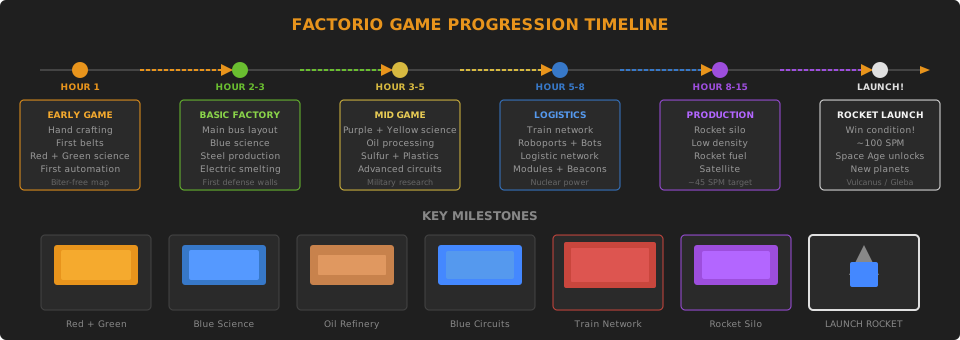
The diagram above shows the 6 major phases of a standard Factorio playthrough. Each phase unlocks new mechanics and challenges.
Your First Hour
What to Do First
Step 1: Open the game and pick a map.
- Click New Game
- Select Freeplay mode (the real game)
- Keep default settings for your first run
- Click Generate
Step 2: Walk around and collect resources.
- Walk with
WASDkeys - Mine resources by holding left-click on rocks/trees
- Pick up everything — ore, wood, stone
- Build your first stone furnace near iron ore
Step 3: Smelt iron and copper.
- Place a stone furnace (press
Eto open build menu) - Put iron ore in the top slot, coal in the bottom
- Wait for iron plates to appear
- Repeat for copper ore
Step 4: Build your first assembler.
- Craft an Assembling Machine 1 from the menu (
E) - Place it near your smelting area
- Insert iron plates → get iron gear wheels
- Insert gears + iron plates → get inserters
Step 5: Automate your first belt.
- Place a transport belt connecting ore to your furnace
- Place an inserter taking plates out of the furnace
- Use inserters to feed the assembler
Key lesson: If you're doing something manually more than once, automate it.
First Science Pack — Red & Green


The Science Pack Progression
Research unlocks new technologies in a specific order. Here's what each science pack unlocks:
| Science | Color | Key Unlocks |
|---|---|---|
| Automation | Red | Belts, inserters, assemblers |
| Logistics | Green | Logistic belts, circuits, automation 2 |
| Military | Yellow | Combat, defense, walls |
| Chemical | Blue | Oil, blue circuits, modules |
| Production | Purple | Productivity modules, beacons |
| Utility | Orange | Nuclear, logistics bots |
| Space | White | Rocket launch, win |
Build a science lab as soon as you have red science — it unlocks everything else.
Building Your First Mall
A Mall (short for "shopping mall") is a factory section that produces everything you need to expand:
- Inserters (all types)
- Underground belts
- Splitters
- Assembling machines
- Miners
- Smelting columns
- Power poles
- Science packs
Why build it? Instead of hand-crafting 200 inserters for your train network, you just drive to the mall and pick them up.
Pro tip: Build your mall next to your main base but with its own smelting. Keep the production separated.
The Main Bus Layout
The main bus is the most popular beginner-friendly factory design. It works like a highway:
- Lanes run in parallel — Iron plates on lanes 1-4, copper on 5-8, etc.
- Branches off — Splitters take items from the bus as needed
- Easy to expand — Just add more lanes when you run out
The 4-lane bus rule: Start with 4 iron and 4 copper lanes. This is enough for most early-game bases.
Common Beginner Mistakes
Not enough smelting early. Every beginner under-builds smelting. You need at least 24 electric furnaces per resource type to keep up with mid-game demand.
No defense until biters attack. By the time biters are at your walls, it's too late. Build walls and turrets as soon as you have military science.
Not researching efficiency modules. Efficiency Module 1 reduces pollution by 30% for almost no cost. Research this early to reduce biter aggression naturally.
Controls Quick Reference
| Key | Action |
|---|---|
WASD | Move character |
E | Open build menu |
Q | Open deconstruction menu |
Shift + Click | Quick build (no confirmation) |
Alt | Toggle entity info overlay |
Ctrl + Click | Copy-paste building settings |
F | Rotate building |
Z | Toggle zoom |
M | Open map |
B | Open blueprint book |
Related Guides
- Science Pack Recipes — Exact recipes and ratios for all 7 science packs
- Production Ratios — Smelting, circuit, and beacon math
- Base Design — Main bus, city blocks, and megabase design
- Defense — Turrets, walls, and pollution management