Your coal power graph is in the red. You expanded three new outposts and the steam engines are barely keeping up. Before you paste 10,000 solar panels — nuclear: 480 MW fits in the space of 8 solar panels, one uranium patch lasts hundreds of hours, and the UPS hit is negligible.
The Root Cause — Why Coal Eventually Caps Out
At 40+ steam engines you're spending more time laying belts than building your factory. Coal patches deplete. Belt throughput maxes out. Solar works but the space requirement becomes absurd — 480 MW needs roughly 8,000 panels plus 6,700 accumulators.
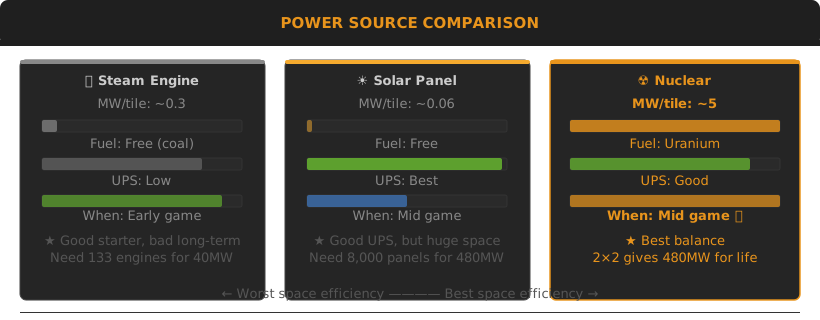
A single 2×2 nuclear block delivers roughly 55 MW per tile loaded. For comparison, the same tile footprint with solar would net you 0.6 MW on a good day.
Building the Fuel Chain First
Reactors need a lot of steel and circuits. Use our Smelting Ratios Guide to plan your steel furnace columns before you scale up. Before you place a single reactor, set up fuel production. The nuclear chain needs three stages:
Stage 1 — Uranium mining. One electric mining drill on a uranium patch produces enough ore for a 2×2 reactor. The catch: you need sulfur for sulfuric acid (10 acid per ore). Run a pipe from your oil base.
Stage 2 — Centrifuge processing. Each centrifuge runs a 12-second cycle. 10 uranium ore in → 99.3% U-238 + 0.7% U-235. Without modules you'll net roughly 1 U-235 per 140 cycles. Start at least 5 centrifuges.
Stage 3 — Fuel cell assembly.
- 19 U-238 + 1 U-235 → 10 fuel cells
- Burn time: 200 seconds per cell
- Consumption: ~18 cells/hour per reactor
- A 2×2 burns ~72 cells/hour
One assembler with speed modules running for 5 minutes produces enough cells for hours.
The Proven Fix — 2×2 Reactor Layout
Four reactors touching in a square. Each adjacent reactor adds +100% heat output (neighbor bonus). This is the standard for a reason.
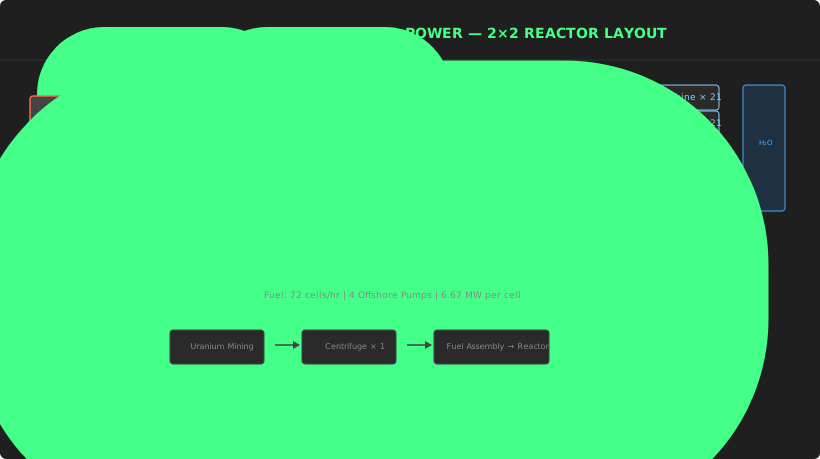
Neighbor bonus math:
- Corner reactors: 1 neighbor → +100% = 80 MW each
- Center reactors: 2 neighbors → +300% = 160 MW each
- Total: 480 MW from 4 reactors
The exact component list for a 2×2:
- Reactors: 4 (must touch)
- Heat exchangers: 48 (12 per reactor worth of output)
- Steam turbines: 84 (21 per reactor worth)
- Offshore pumps: 4 (one per 12 heat exchangers)
- Fuel cells per hour: 72
Understanding Heat Pipe Physics (Where Most Builds Fail)
Heat travels through pipes like a fluid with two hard limits:
- Range: ~16 tiles from reactor before meaningful dropoff begins
- Capacity: One heat pipe segment handles heat for ~4 heat exchangers
The three rules that prevent a brownout:
- Keep heat pipes within 20 tiles of the reactor
- Run double pipes for 2+ wide reactor rows
- Place exchangers on both sides — not just one
- More pipes increase capacity, not range
For a 2×2, use 3-5 parallel heat pipes running from the reactor block to the exchanger array. Single-file heat pipes will choke at scale.
The Bootstrapping Problem — Getting Kovarex Started
Kovarex converts 40 U-235 + 5 U-238 → 41 U-235 (+5 U-238 recipe cost, net +1 U-235 per cycle). Once running, it produces U-235 faster than any reactor block can burn it.
The bottleneck: Getting 40 U-235 to start. At 0.7% enrichment with 5 centrifuges, that's about 2-3 hours of continuous mining and processing.
Skip the wait:
- Start centrifuges the moment you research uranium processing — even before you build the reactor
- Prod modules in centrifuges speed this up significantly
- If 40 U-235 feels slow, don't wait — build your reactor on the first 10 and run it manually with solar as backup
Traps People Keep Falling Into
Not enough water. One offshore pump feeds 12 heat exchangers. Period. A 2×2 needs 4 dedicated offshore pumps. Running more exchangers per pump causes steam starvation that's hard to diagnose.
Heat pipe too long. Past ~16 tiles, heat transfer drops off a cliff. You can extend it with more parallel pipes, but after 25 tiles you need a separate reactor row.
Overproducing fuel cells. 72 cells per hour is the burn rate. One assembler running for 5 minutes keeps you running for hours. Do not build four assemblers.
Ignoring the neighbor bonus. A 2×2 sharing bonuses produces 480 MW. Four standalone reactors with the same fuel produce 160 MW. The difference: touching the reactors.
In a city block megabase, power is typically a dedicated block with its own train station for fuel delivery.
Scaling Past 1 GW
For megabase power, use tileable 2×N rows:
| Configuration | Reactors | Cells/hr | Total MW | MW/cell | When to build |
|---|---|---|---|---|---|
| Single 1×1 | 1 | 18 | 40 | 2.2 | Test setup |
| 2×1 row | 2 | 36 | 160 | 4.4 | Early expand |
| 2×2 square | 4 | 72 | 480 | 6.7 | Standard |
| 2×4 | 8 | 144 | 1,120 | 7.8 | Full megabase |
Each additional reactor pair adds roughly 160 MW. A 2×8 setup pushes 2,240 MW — enough for any base size achievable without UPS mods.
Community Verification & Resources
- Official Factorio Wiki — Nuclear Power — exact heat exchange formulas and pipe throughput tables
- Factorio Forums — Nuclear Power Discussion — community reactor blueprints and bug reports
- Alt-F4 Blog — Nuclear Throughput Deep Dive — engineering analysis of heat pipe mechanics
- Kirk McDonald's Factorio Calculator — exact ratios for any reactor configuration